

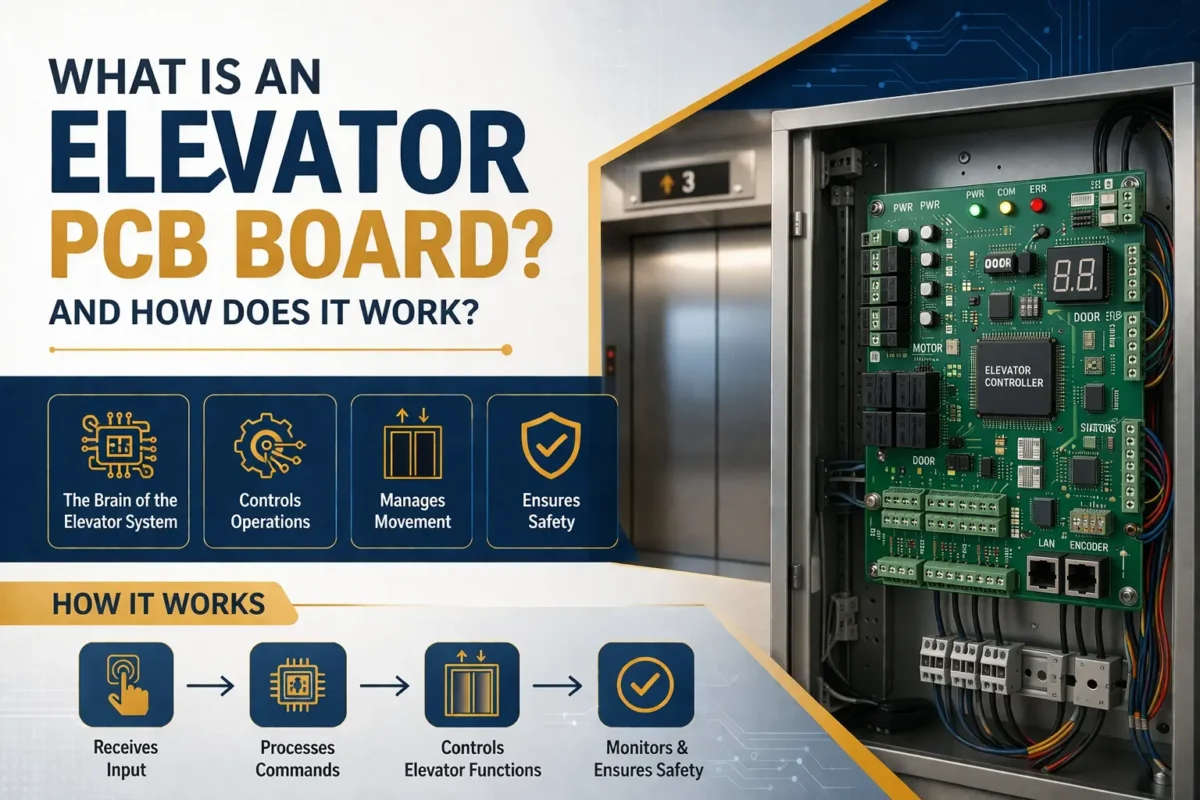
Elevator faults are often blamed on motors, doors, or mechanical wear. In reality, many performance issues begin in the control electronics—especially the PCB board.
Although physically compact, the PCB board helps coordinate movement commands, door functions, call signals, and several safety-related responses.
If the PCB board fails, the entire elevator system can behave unpredictably or stop working completely.
That is why understanding the elevator PCB board matters, especially if you manage a building, maintain lifts, or buy elevator spare parts.
In this guide, you will learn:
- What is an elevator PCB board?
- How it works
- its main components
- common PCB board problems
- when to repair or replace it
Let’s break it down in simple terms.
What Is an Elevator PCB Board?
An elevator PCB board is an electronic control board used inside an elevator system to manage and coordinate different functions.
PCB stands for Printed Circuit Board.
It functions as a decision-making and signal-routing layer within the elevator’s control architecture.
The board helps control important tasks such as the following:
- elevator movement
- floor selection
- door opening and closing
- signal communication
- safety response
- motor control
- error detection
In simple words, the PCB board helps the elevator “think” and respond correctly.
Without it, the lift cannot operate smoothly or safely.
Why Is an Elevator PCB Board Important?
Modern elevators are no longer just mechanical machines.
They depend heavily on electronic control systems.
The PCB board helps connect and control many critical lift functions.
Main reasons it is important:
- controls elevator movement
- manages command signals
- supports safe operation
- improves ride performance
- helps detect system faults
- connects sensors and control devices
- supports automation and floor accuracy
If the PCB board has a fault, the elevator may
- stop suddenly
- not respond to floor calls
- fail to open doors properly
- show error signals
- run unevenly
- face communication problems
That is why the lift control board is one of the most important elevator spare parts.
How Does an Elevator PCB Board Work?
To understand it simply, think of the PCB board as a control center.
It receives signals, processes them, and sends commands to different parts of the elevator.
Here’s how it works step by step:
1. Receives Input Signals
The PCB board receives information from the following:
- floor buttons
- cabin buttons
- door sensors
- limit switches
- overload sensors
- safety devices
- control panels
For instance, when a passenger selects a floor, the board interprets that input alongside door status, car position, and safety interlock conditions before allowing movement.
2. Processes the Command
The board analyzes the request and decides:
- which direction the elevator should move
- whether the lift is free or occupied
- whether safety conditions are normal
- whether the door is closed properly
3. Sends Output Commands
After processing the signal, the PCB board sends instructions to the following:
- motor drive system
- door operator
- display panel
- braking system
- floor indicator
- inverter or controller
This is how the lift starts moving to the selected floor.
4. Monitors Safety During Operation
While the lift is moving, the PCB board keeps checking:
- floor position
- speed signals
- door lock condition
- overload status
- emergency safety signals
If something is wrong, the board can stop the system or trigger an alarm.
Main Functions of an Elevator PCB Board
The elevator PCB board supports many functions inside the lift system.
Key functions include:
1. Lift Movement Control
It helps control the elevator’s travel between floors.
2. Door Operation Control
It helps open and close elevator doors correctly.
3. Floor Signal Processing
It receives and responds to floor call commands.
4. Safety Monitoring
It checks safety inputs before and during operation.
5. Error Detection
It helps identify technical faults and operating errors.
6. Communication Between Components
It connects multiple elevator electronic systems together.
7. Automation Support
It allows smoother, smarter, and more efficient lift performance.
Main Components of an Elevator PCB Board
An elevator PCB board contains several small but important electronic parts.
Here are some common components:
1. Microprocessor / IC Chips
These process commands and system logic.
2. Relays
These switch electrical signals on and off.
3. Capacitors
These help regulate and store electrical energy.
4. Resistors
These help control current flow.
5. Connectors
These connect the board to other elevator components.
6. Fuses
These protect the circuit from overload or short circuits.
7. LEDs / Indicators
These show board status or fault signals.
8. Communication Ports
These allow connection with controllers, inverters, or service tools.
Different elevator systems may use different types of PCB boards depending on:
- elevator brand
- lift model
- controller type
- automation level
- door system
- drive system
Types of Elevator PCB Boards
Not all elevator PCB boards do the same job.
Different boards may be used for different functions inside the lift system.
Common types include:
1. Main Control PCB Board
Controls overall elevator operation.
2. Door PCB Board
Handles door opening, closing, and door safety signals.
3. Display PCB Board
Controls floor indicators and display panels.
4. Inverter PCB Board
Works with the drive system to control motor speed.
5. Cabin Command PCB Board
Handles commands from inside the elevator cabin.
6. Signal Interface PCB Board
Helps communication between multiple system parts.
Each one plays a role in keeping the elevator system stable and responsive.
Common Elevator PCB Board Problems
Like any electronic part, PCB boards can develop faults over time.
This may happen because of:
- voltage fluctuation
- dust and moisture
- overheating
- poor wiring
- aging components
- improper installation
- power surge damage
Common Elevator PCB board problems include the following:
- lift not responding
- floor buttons not working
- door system malfunction
- sudden lift stoppage
- display errors
- communication failure
- motor command issues
- random fault alarms
These issues may start small, but they can lead to bigger lift failures if ignored.
Signs of a Faulty Elevator PCB Board
Sometimes the PCB board does not fail completely right away.
It often gives warning signs first.
Watch for these signs:
- The elevator stops unexpectedly.
- floor selection delay
- door opens or closes abnormally
- The lift does not level properly.
- The display panel flickers.
- unusual control errors appear
- The lift works inconsistently
- system resets frequently
If these signs appear, the board should be checked by a qualified lift technician.
How to Test an Elevator PCB Board
Testing a PCB board should always be done carefully.
Because it is part of an electrical control system, incorrect handling can create safety risks.
Basic testing may include:
- visual inspection for burn marks
- checking loose connectors
- measuring voltage input/output
- testing relay response
- checking fuse condition
- reviewing error codes
- using elevator diagnostic tools
Important note:
PCB board troubleshooting should only be done by trained professionals.
Trying to repair or test a lift control board without technical knowledge can damage the system further.
Can an Elevator PCB Board Be Repaired?
Yes—in some cases, an elevator PCB board can be repaired.
But not every board should be repaired.
It depends on the type and severity of the fault.
Repair may be possible if:
- a fuse is damaged
- a relay has failed
- a connector is loose
- a capacitor is weak
- a minor circuit issue exists
Replacement may be better if:
- The board is badly burned.
- The microprocessor is damaged.
- multiple circuits have failed
- The board is outdated.
- repeated faults keep happening
A proper inspection helps determine the best option.
Repair vs Replacement: Which Is Better?
This is one of the most common questions from building owners and maintenance teams.
Here is a simple rule:
Choose repair if:
- The issue is small.
- The board is still compatible.
- • The repair cost is reasonable.
- Original performance can be restored
Choose a replacement if:
- The damage is serious.
- The board is unreliable.
- The lift keeps failing.
- long-term safety is affected
In many cases, replacing a weak PCB board can save more money over time than repeated short-term repairs.
How to Choose the Right Elevator PCB Board
If you need to replace or buy a PCB board, choosing the correct one is very important.
A wrong board can create communication issues, poor performance, or system failure.
Before buying, check these points:
1. Elevator Brand Compatibility
Make sure it matches the lift brand and model.
2. Board Function
Confirm whether it is for:
- control system
- door operation
- display system
- inverter
- cabin panel
3. Part Number
Always check the exact PCB board code or part number.
4. Original vs. Generic
Original or compatible quality parts are safer than low-grade copies.
5. Supplier Reliability
Buy from a trusted elevator spare parts supplier.
6. Technical Support Availability
A good supplier should also help with identification and compatibility.
Why PCB Board Quality Matters
A low-quality PCB board may seem cheaper at first.
But it often creates bigger problems later.
Poor-quality boards may cause the following:
- unstable lift performance
- repeated breakdowns
- safety risks
- shorter lifespan
- communication failure
- expensive maintenance
A good-quality elevator PCB board improves the following:
- control accuracy
- safety
- durability
- reliability
- system stability
That is why PCB board quality should never be ignored.
Where Elevator PCB Boards Are Commonly Used
Elevator PCB boards are used in many types of lift systems, including:
- passenger elevators
- home elevators
- hospital lifts
- freight elevators
- capsule elevators
- machine roomless elevators
- commercial building lifts
- apartment building lifts
No matter the building type, the PCB board remains a key control component.
Why Professional Support Matters
An elevator PCB board is not a basic electrical item.
It is a critical lift control component.
That means:
- • A correct diagnosis matters.
- Correct installation matters.
- Correct programming may matter.
- Correct replacement matters.
Working with an experienced elevator spare parts supplier or service team helps reduce mistakes and downtime.
Frequently Asked Questions (FAQ)
Q1: What is the function of an elevator PCB board?
An elevator PCB board controls important lift functions such as movement, door operation, signal response, and system safety.
Q2: Can an elevator run without a PCB board?
No. Modern elevators rely on PCB boards to manage control and communication functions.
Q3: What causes an elevator PCB board to fail?
Common causes include voltage fluctuation, overheating, moisture, dust, component aging, and electrical faults.
Q4: Can a faulty elevator PCB board be repaired?
Yes, some minor PCB faults can be repaired. But severe damage may require full replacement.
Q4: How do I know if my elevator PCB board is bad?
Common signs include lift stopping unexpectedly, button failure, display issues, door malfunction, and system errors.
Q5: Is it better to repair or replace an elevator PCB board?
It depends on the damage, cost, compatibility, and long-term reliability of the board.
Need Elevator PCB Board Support?
If you are looking for elevator PCB boards, lift control boards, or original elevator spare parts, it is always best to choose a trusted supplier with technical knowledge and reliable support.
A quality part today can prevent a costly lift problem tomorrow. Need help choosing the right elevator PCB board for your system?
Get in touch with a professional elevator spare parts supplier for the right match and expert support.