

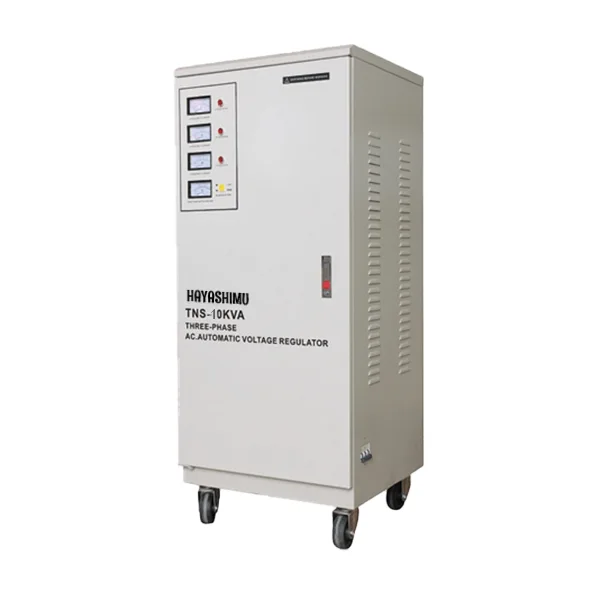
Elevator 10KVA Automatic Voltage Regulator
| Specification | Details |
|---|---|
| Current Type | AC |
| Phase | 3 Phase |
| Input Voltage Range | 304 – 456V AC |
| Input Frequency | 50Hz / 60Hz |
| Output Voltage | 380V / 400V / 415V ±3% |
| Output Frequency | 50Hz / 60Hz |
| Efficiency (AC-AC) | >95% |
| Protection (Under Voltage) | 318 ±7V |
| Protection (Over Voltage) | 426 ±7V |
| Protection (Bypass) | Yes (Manual / Auto Optional) |
| Acoustic (Noise Level) | <50 dB |
| Humidity | 20% ~ 90% |
| Operating Temperature | -5°C ~ 45°C |
Why 10kVA is the Standard for Home Lifts
1. Matching the Motor Size
Most home elevators use a permanent magnet synchronous motor (PMSM) or a small hydraulic pump ranging from 2.2kW to 5.5kW. A 10kVA AVR provides the necessary “headroom” to handle the starting torque and current inrush without causing a voltage dip that could dim the lights in the rest of the house.
2. Safeguarding the Integrated Controller
Modern home lifts use sophisticated integrated drives (like the Monarch NICE1000+). These boards are sensitive to “brownouts.” A 10kVA AVR ensures the control logic remains powered during a dip, preventing the lift from stopping abruptly between floors.
3. Silent Operation
Because many 10kVA units are installed in or near residential living spaces, they are designed for lower acoustic noise. High-quality units use dampened servo motors or static switching to ensure the regulator doesn’t create a loud humming sound during the stabilization process.
Key Components of an Elevator AVR
-
Buck-Boost Transformer: The “muscle” of the unit that physically adjusts the voltage levels.
-
Carbon Brush & Commutator: (In Servo types) Moves along the copper windings to find the exact voltage point.
-
Control Board: The “brain” that monitors the input 50/60Hz frequency and voltage, directing the motor to move the brushes instantly.
-
Digital Display: Shows real-time Input/Output voltage and current (Amps) for easy troubleshooting.








Reviews
There are no reviews yet.