


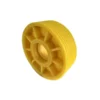
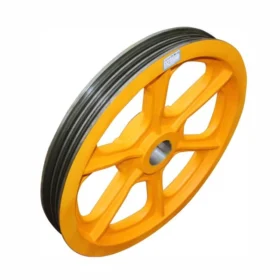
Elevator Pulley For Cabin, Counterweight & Motor Base
1. Cabin & Counterweight Pulleys (Deflector Sheaves)
These pulleys are typically mounted on top of the elevator car (cabin) or the counterweight frame in 2:1 or 4:1 roping systems.
-
Function: They allow the hoisting ropes to pass under or over the cabin and counterweight, providing the necessary mechanical advantage to lift heavy loads with less motor torque.
-
Material Construction:
-
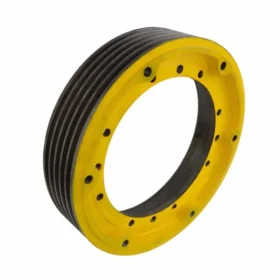
Nylon/MC (Monomer Casting) Nylon: Increasingly popular for modern high-speed elevators. They are lightweight, reduce noise, and significantly extend the lifespan of the steel wire ropes due to lower friction and better pressure distribution.
-
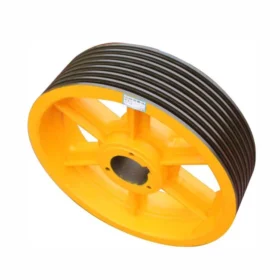
Cast Iron (Ductile Iron): Traditional and highly durable, used for heavy-duty freight elevators or systems where high heat dissipation is required.
-
-
Bearings: Usually equipped with high-precision deep groove ball bearings or spherical roller bearings to ensure smooth, maintenance-free rotation.
2. Motor Base Pulleys (Diverter Sheaves)
Located near the traction machine on the motor base or in the machine room overhead, these are primarily used to “divert” the ropes.
-
Function: Their main job is to increase the distance between the center of the cabin and the center of the counterweight, ensuring the ropes hang vertically and do not rub against other components.
-
Groove Profiles:
-
U-Groove: Common for diverter sheaves as they provide support without the “pinching” effect required for traction.
-
Undercut U-Groove: Occasionally used if a small amount of additional stability is needed.
-
-
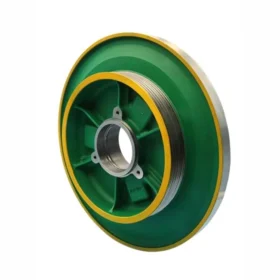
Installation: These are often heavy-duty cast iron sheaves mounted on a fixed shaft with heavy-duty pedestals to withstand the combined weight of the car, counterweight, and rated load.
3. Technical Specifications Table
| Feature | Cabin/Counterweight Pulley | Diverter (Motor Base) Pulley |
| Typical Diameter | 240 mm – 450 mm | 320 mm – 650 mm |
| Common Materials | MC Nylon, Polymer, Cast Iron | Cast Iron, Ductile Iron |
| Roping Ratio | 2:1, 4:1 | 1:1, 2:1 |
| Primary Goal | Mechanical advantage / Support | Distance compensation / Alignment |
| Maintenance | Check for groove wear & bearing noise | Check for alignment & rope tension |
4. Key Factors for Replacement
When sourcing or replacing these pulleys, technical precision is vital to ensure safety and code compliance (EN 81 or ASME A17.1):
-
D/d Ratio: The ratio between the pulley diameter ($D$) and the rope diameter ($d$) must typically be at least 40:1 to prevent rope fatigue.
-
Groove Hardness: For metal sheaves, the hardness of the grooves must be compatible with the wire ropes to prevent premature “imprinting” or “necking” of the ropes.
-
Static Load Capacity: Every pulley is rated for a maximum static load; exceeding this can lead to shaft failure or bearing seizure.







Reviews
There are no reviews yet.